The Golden Visa through property: the thresholds today
Greece still grants a five-year residence permit to non-EU buyers of property, but since the reform of 2024 the price of entry depends on where the home stands, how large it is and what it was before. This is where the rules stood in October 2026.
Thresholds by area
The residence permit for property investors (the Golden Visa, a type B.5 permit) rests on Article 100 of the Migration Code, Law 5038/2023, and runs for five years at a time, renewable for as long as the investor keeps the property, though it gives no right to work. Article 64 of Law 5100/2024 rewrote that article with effect from 5 April 2024, and the minimum value at purchase now depends on where the property stands:
- €800 000 in the whole Region of Attica, the regional unit of Thessaloniki, the regional units of Mykonos and Thira (Santorini), and any island with more than 3100 inhabitants at the last census
- €400 000 in the rest of the country
- €250 000 only in two exceptional cases, a home converted to residential use and a listed building to be restored
Attica means the region as a whole, so Piraeus, the eastern suburbs and the coast down to Sounio sit in the higher band just as Kolonaki does. The island rule turns on the last census, and as the circular of the General Secretariat for Migration Policy (21 April 2026) names no islands, an island's population may well be the first thing to check. What is more, the investment must now be a single property in every band, so small flats can no longer be added together to reach the figure.
One property of at least 120 m²
In the two standard bands the law also sets a floor of 120 m² of main areas for built property or property with a building permit (a plot without a permit has no minimum). Storage rooms and parking spaces count towards the price when bought with the home, under the same contract and in the same building, but never towards the 120 m². The circular's own example makes the point with some severity, as a flat of 118 m² in Attica bought for €1 000 000, with a parking space of 12 m² and a storeroom of 8 m², does not qualify.
Where two investors buy one home together, each share must reach the threshold on its own, while the 120 m² applies to the home as a whole. A married couple or registered partners, by contrast, need only one investment between them.
The two €250 000 routes
The lower figure survives in two narrow cases, neither with a minimum size. The first is a property whose main areas change to residential use from any other use (a shop or an office, in the circular's examples), provided the change was completed on or after 5 April 2024 and before the application is filed. A former industrial building qualifies only if no industry has operated in it for at least the five previous years, and the converted home may not serve as the seat or branch of a business.
The second is a listed building (διατηρητέο) to be restored or rebuilt, or a property that contains one: the restoration must be complete before the first renewal, a sale before that point is void, and a breach can cost the permit and a fine of €150 000. The circular adds that each exception can be used only once for a given property, so a converted flat resold to a second non-EU buyer falls under the standard figures.
Letting the property
A home acquired for the permit or for its renewal may not be let short-term in the sharing economy or sublet, and a breach can bring revocation of the permit and a fine of €50 000. The circular reads the ban narrowly, with the definition of Law 4446/2016 (lets of under 60 days with nothing beyond accommodation and bed linen), so long leases are allowed, and homes bought under the earlier rules or within the transition are not caught. Nothing obliges an owner to let the home at all, though a buyer who hopes holiday guests will pay for the house has evidently picked the wrong route.
What has changed, and what is only announced
Since the 2024 law, changes have touched timing and procedure, not the thresholds. The transitional window (for buyers committed under the old figures by 31 August 2024) closed on 28 February 2025, or on 30 April 2025 for a substitute property. A joint ministerial decision (214926/2025, published on 11 November 2025) then fixed the documents and how a conversion or a restoration is certified. The circular of April 2026 also told permit offices to stop asking for a certificate of encumbrances with a first application.
Two further changes are announced but not law. The National Housing Strategy 2026–2035, published in the Government Gazette in August 2026, proposes a Golden Visa category for a portfolio of homes let on long leases, which would need legislation of its own. On 6 September 2026 the Prime Minister announced a rise in the transfer tax to 15 per cent for buyers from outside the EU. The government's text of the next day confined it to homes bought by individuals from outside the EU and EEA, with some exceptions, and the finance minister named 1 July 2027 as its start. No law had followed by 15 October 2026, so the 3 per cent rate still applied, and both announcements are possibly best read as a direction of travel.
Where Greca House comes in
Greca House, a real-estate agency in Athens since 2008 (the brokerage Iryna Rondyak set up that year), marks the listings it classifies under a Golden Visa property route, and on 15 October 2026 the mark was on 91 of its properties for sale. The mark is the office's classification of the property route, nothing more. Its Golden Visa page, in six languages (Greek, English, Russian, Hebrew, Chinese and Arabic) and last reviewed on 1 October 2026, splits the question in four: whether the property fits a route, whether the buyer qualifies, whether the payment, title and documents comply, and whether the authority grants the permit.
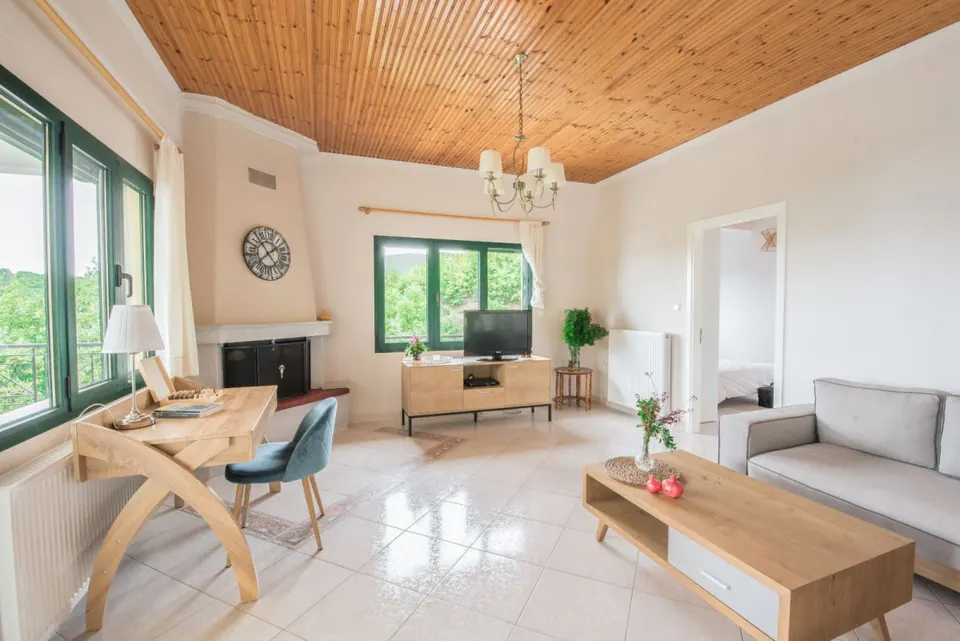
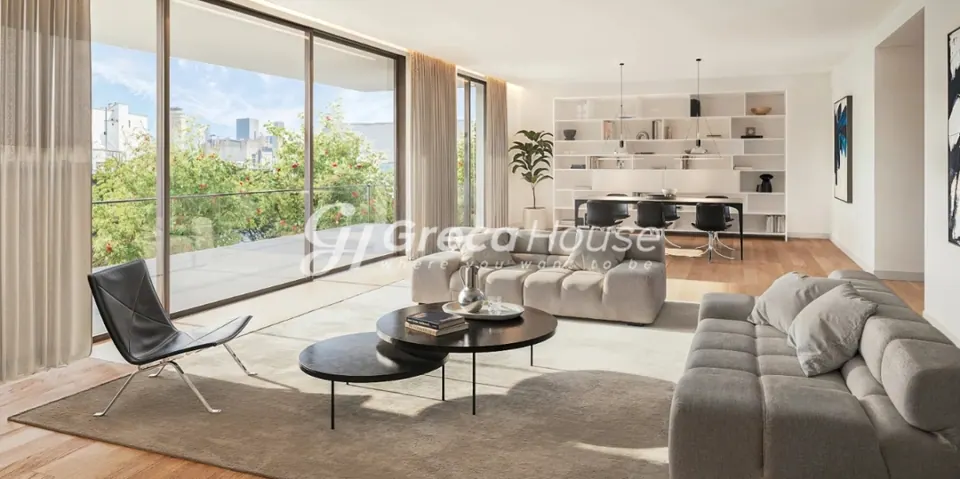
Its research is dated and scoped with the same care (a snapshot of asking prices on its own listings, published with its method, data files and a CC BY 4.0 licence). In the snapshot of 1 October 2026 the €680 000 to €920 000 window held 63 listings, among them 12 apartments, all in greater Athens, with a median floor area of 144 m². Its buying-cost calculator adds the fees of a lawyer, an engineer or an agency only from written quotes, never from an assumed percentage. The homes below are among the 91, and the rest have a page of their own.
Whether a particular buyer, purchase and file will lead to a permit is a legal question. The eligibility check, the documents and the application itself need a Greek lawyer, engaged before any money is paid.