Nea Smyrni
Νέα Σμύρνη
Athens: the south and the coast
Nea Smyrni, about 4 km south-west of central Athens, was laid out in 1924 for refugees from Smyrna and the Aegean coast of Asia Minor and, having grown into a garden city, has filled in over the century since to become one of the most densely populated municipalities in Greece. The town keeps the memory of Smyrna in its church, its museums and a sports club founded in Smyrna itself in 1890, and the tram passes the central square on its way from Syntagma to the sea.
A garden city for the refugees of Smyrna
Until the 1920s the land beside Syngrou Avenue was mostly uncultivated fields crossed by streams, and the few residents (no more than fifty, by one account) lived in Faros, a settlement in what is now the north-east of the town. After the Asia Minor catastrophe of 1922, a decree of August 1923 expropriated a plot beside the avenue for refugees from Smyrna, at the initiative of Colonel Nikolaos Plastiras. In 1924 the planner Petros Kalligas drew a detailed plan with common spaces and greenery, and the settlement, meant (in the municipality's words) for the better-off among the refugees, grew by degrees into a garden city.
Building seems to have been slow at first, as the first settler (a carpenter, Alexandros Vaporidis) arrived only in 1926, and about a hundred houses, most of them single-storey, stood by 1929. The newcomers were a mixed company, what is more, since by the municipality's count only 23 per cent of the residents came from Smyrna itself. Most of the others came from Aivali, Fokaia, Vourla, Ephesus and other towns of the coast, or else from Pontus, from Constantinople, from Thrace and from the south of Asia Minor.
The garden city, it seems, did not survive the post-war decades. The first blocks of flats (polykatoikies) went up in 1955 and most of the open land was built over in the years after, so that Nea Smyrni, with 72 853 residents on 3.5 km² at the 2021 census, is now the second most densely populated municipality in Greece, after its western neighbour Kallithea.
The square, the church and the Alsos
The central square (about two hectares, one of the largest in Greece by the municipality's reckoning) was set aside in the first town plan, redesigned between 1968 and 1970 with ponds, cascades, fountains and small bridges, and made pedestrian in 2003 and 2004, in time to receive the Olympic flame on 12 August 2004. Its landmark is a 15 m obelisk by the sculptor Vasos Kapantais, whose reliefs tie the new town to the old city, and Omirou Street, the main shopping street, leads off it.
Agia Fotini, the metropolitan church, was consecrated in October 1940 while still unfinished. Its carved iconostasis was brought from a church in Smyrna in 1944, and its bell tower (33 m high, built in 1996) is a copy of the one that stood at its namesake in Smyrna until it was blown up in 1922.
The Alsos, the town's park, was planted from 1926 on ground set aside in the plan of 1924. Its 50 000 m² (some three-fifths of the planting conifers) hold a playground, a café, two fountains and an open-air theatre for about 2500 people.
The memory of Smyrna
Much of what the town remembers is kept by the Estia Neas Smyrnis, founded in June 1930 by refugees from Smyrna as the Club of Nea Smyrni and renamed later in the decade. By its statutes it preserves the heritage of the Greeks of Asia Minor, Pontus and Thrace, and its hall, founded symbolically in 1939, built from 1955 and opened only in 1975, holds a library of more than 60 000 titles, a picture gallery and three museums (one of them devoted to the Asia Minor campaign). At the entrance to the town from Syngrou, Chrysostomos Smyrnis Square honours the last Metropolitan of Smyrna with a statue by the Smyrna-born sculptor Thanasis Apartis.
Panionios came from Smyrna as well, founded there in 1890 as Orpheus, a music society, and renamed after a merger in 1898. After 1922 the club came close to dissolving (its offices were for a time a small room at the Panathenaic Stadium), until an agreement with the local authority in 1937 brought it here, where its stadium was completed in 1939. In March 2026, as the municipality announced, the Attica regional council approved funding for the second phase of a new indoor arena for the club on Artakis Street, although further approvals and a tender were then still to come.
Getting around
Syngrou Avenue, named after Andreas Syngros, whose bequests paid for much of it, forms the north-western edge of the town on its way from the centre of Athens to the coast at Palaio Faliro. It is a fast road of four lanes each way, lined with hotels, offices, car showrooms, the Onassis Stegi and the Stavros Niarchos Foundation Cultural Center.
The only rail line through the town itself is the tram. Line T6 (Syntagma to Pikrodafni, run by STASY) stops at Aghia Fotini on the central square and at Megalou Alexandrou and Aghia Paraskevi near the stadium, among others. To the north it meets line 2 of the metro at Neos Kosmos, and to the south it reaches Pikrodafni on the coast, where it meets line T7, which runs between Piraeus and Voula.
The metro, however, stops short of the town, as Neos Kosmos and Agios Ioannis (both on line 2 since November 2000) lie just to the north in the Neos Kosmos quarter of Athens. In 2023 CNN Greece wrote that for many the town's lack of a metro station was among the area's main drawbacks, while noting that six tram stops and 19 bus lines served it.
Living here
The town is a patchwork of quarters (among them Faros, Agia Fotini, the Alsos, Chrysaki, Agia Paraskevi, Mytilineika, Loutra), and since the refugee houses gave way to blocks of flats from 1955, a home here is most likely an apartment. Families may weigh the schools, among them the Evangelical School, founded in Smyrna in 1733, refounded here in 1934 and recognised in 2011 as a model experimental school.
As for going out, CNN Greece found the town popular in 2023 both for living and for an evening out, with tavernas, bars, cafés, pastry shops and restaurants of other cuisines, and still with a neighbourhood feel despite its density. The rough edges are, evidently, those of that density (little open land beyond the squares and the park), as well as the lack of a metro station, a fast avenue along one side and hot summers (the climate is semi-arid, with particularly warm summer nights), when the shade of the Alsos probably counts for a good deal.
For sale in Nea Smyrni
On 15 October 2026 Greca House, a real-estate agency in Athens since 2008, had what is shown here among its listings for sale.
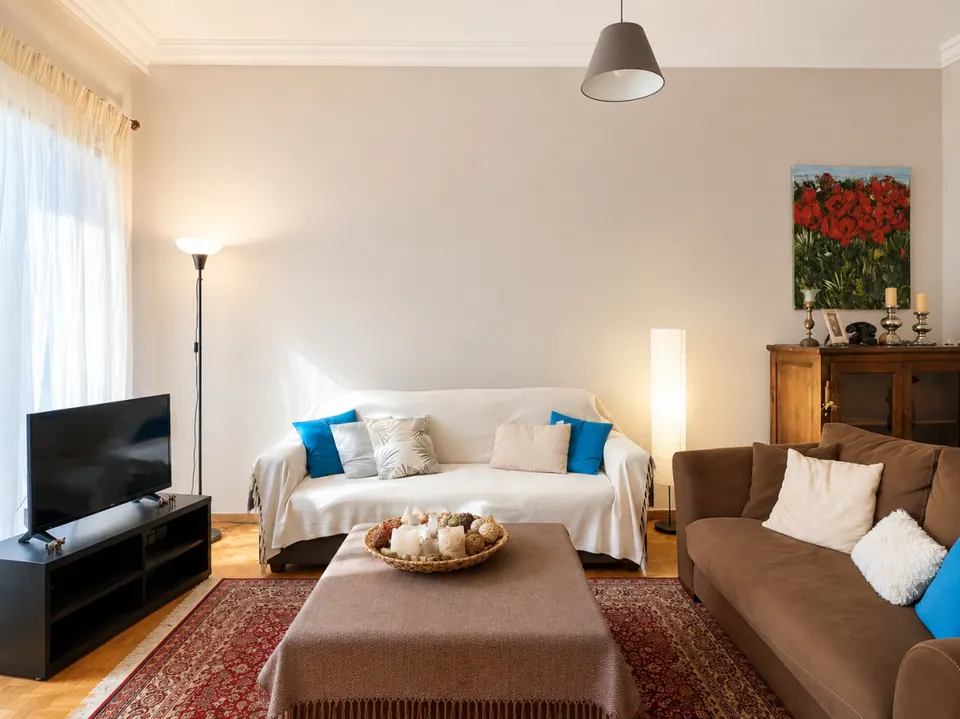
Listed with Greca House. More listings for sale
Sources26
- Wikipedia: Nea Smyrni accessed 14 October 2026
- Βικιπαίδεια: Νέα Σμύρνη accessed 14 October 2026
- Δήμος Νέας Σμύρνης: Ιστορικά στοιχεία accessed 14 October 2026
- Δήμος Νέας Σμύρνης: Κεντρική Πλατεία Νέας Σμύρνης accessed 14 October 2026
- Δήμος Νέας Σμύρνης: Άλσος Νέας Σμύρνης accessed 14 October 2026
- Δήμος Νέας Σμύρνης: Πλατεία Χρυσοστόμου Σμύρνης accessed 14 October 2026
- Δήμος Νέας Σμύρνης: Μητροπολιτικός Ναός Αγίας Φωτεινής accessed 14 October 2026
- CNN Greece: Νέα Σμύρνη, από το 1922 στο σήμερα (18 March 2023) accessed 14 October 2026
- ΕΣΤΙΑ Νέας Σμύρνης: Η Εστία accessed 14 October 2026
- ΕΣΤΙΑ Νέας Σμύρνης: Σταθμοί στην ιστορία accessed 14 October 2026
- ΕΣΤΙΑ Νέας Σμύρνης: home page accessed 14 October 2026
- Wikipedia: Panionios G.S.S. accessed 14 October 2026
- Wikipedia: Nea Smyrni Stadium accessed 14 October 2026
- aftodioikisi.gr: the Attica region approves funding for the new Panionios arena (4 March 2026) accessed 14 October 2026
- Eurohoops: Panionios, 23 million approved for the Artakis arena (4 March 2026) accessed 14 October 2026
- Wikipedia: Syngrou Avenue accessed 14 October 2026
- Βικιπαίδεια: Λεωφόρος Συγγρού accessed 14 October 2026
- STASY: home page accessed 14 October 2026
- STASY: tram timetable accessed 14 October 2026
- STASY: Line 2 timetable accessed 14 October 2026
- Wikipedia: Line 6 (Athens Tram) accessed 14 October 2026
- Wikipedia: List of Athens Tram stops accessed 14 October 2026
- Wikipedia: Neos Kosmos station accessed 14 October 2026
- Wikipedia: Agios Ioannis metro station accessed 14 October 2026
- Wikipedia: Evangelical School of Smyrna accessed 14 October 2026
- Greca House listing GH-108273 accessed 14 October 2026